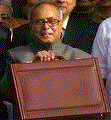
Monday, March 7, 2011

Finally, eyes are open! :)


The recent move of FM to raise funds for infrastructure development through corporate bonds has finally given thrust to the nascent Indian debt market.

A well-functioning capital market is an important prerequisite not only for financial inclusion, but also for economic development and growth.

In a developed economy, banks and capital markets often complement each other, allowing movement of surplus funds to find their most productive use, and, in the process, freeing up capital and improving liquidity that allows banks to finance a larger number of players than was hitherto possible. Critical to such a movement is the existence of an efficient secondary market where previously issued financial instruments can be traded.

The retails participation is very low in debt market in India, compared to other countries and also compared to the equity financial market in the country. The tax benefits given to these investment options which are above section 80c 1 lakh limit is giving a growth pill to the debt markets.

Better late than never, we are in the game now… welcome the new Indian financial transformation.

Friday, February 18, 2011

Reading Pranab-da's Mind!!


Pranab’da! Let me try to read your mind now. I think the following points would be the crux of your delivery on 28th Feb.

1) A social sector spending like NREGA, food security, right to education etc.. might come up this time to win hearts of five states where elections are due to held this year.. J

2) Companies are requesting you to decrease the minimum alternate tax as it is hitting their balance sheets badly. Also the carry forward period to be extended which can encourage more industrial growth.

3) Positive announcement for agriculture (Fertilizers etc..) to boost productivity and control food inflation is expected.

4) More infrastructure spending. Don’t worry about deficit balancing; we have disinvestment and spectrum sale this year!

5) PPP model in education sector can improve the literacy levels. Start taxing corporate education sir! Enough that people have taken advantages.

6) Reforms like R-ADARP, RGGVY, and Bharat Nirman to continue for power sector encouragement.

7) Service Tax: VAT vs GST… I don’t want to comment… But you will be forced to…Eagerly waiting for that. J

8) Some more income tax exemption please!! Let’s keep it 2Lakhs.. and Pranab’da! If you exempt more tax, more compliance: (ECONOMICS: LAFFER CURVE).. So good for both of us. ;)

9) How about setting free diesel prices also?

10) Increase duties might hamper growth, it your business anyway! It would be good if status quo continues.

Sunday, January 30, 2011

Warning : Filling up petrol could be hazardous to your WEALTH!


I came across a surprising article which says that crude oil pricing is significantly determined by speculative forces in international market and not much by supply and demand!

In case if the speculative forces take the price of crude to 200 dollars per barrel, will the government pass on this burden to common man!!

Come on! Welcome to second Zimbabwe! The price of petrol would then reach Rs.100 liter and perhaps the price of cooking gas will touch Rs.600 per cylinder. I know salad meal is good for health! J

Here petrol is fuel not only for an automobile, but also for scaring inflation.

Adding to this, Planning Commission deputy chairman Montek Singh Ahulwalia says that “India should get used to high energy prices”.

Infact we have ways out!!

Why can’t we learn from Vietnam that has barely any refining facilities and is totally dependent on imports which took commendable decisions to shield the people from the burden by “Price Stabilisation Fund”?

There the government had cut the import taxes on petroleum products twice in recent months, lowering the tax on imported petrol from 20 per cent to 6 per cent and the tax on diesel from 15 per cent to 2 per cent. Now it has been made zero.

And here!! Lowering of tax is a joke!! Apart from taxes on petroleum product, last year Government even darted to imposd 5% import duty on crude oil.

Can you see some common sense missing?

At last – “Government needs revenues at the cost of common man’s bread and butter!!

PS: I suggest reader to go through the sources mentioned below for more insights. In my try to keep the article terse, I have touched many words just superficially.

This post also coincides with the occasion of 1000+ hits for my blog!! Thank you readers :)

Sources:

1) http://indiacurrentaffairs.org/petro-hike-glaring-contrast-between-india-and-vietnam-n-s-arjun/

2) http://www.aip.com.au/pricing/crude.htm

3) http://www.livemint.com/2010/12/16141050/India-should-adjust-to-high-en.html

4) http://www.kshitij.com/research/petrol.shtml

Friday, January 21, 2011

Creating Moral Bonds by Balancing Deficits and Surpluses


The Recent move by China to buy Spanish Debt shows the real meaning of mutually beneficial moves by economies. It might not completely pull the country out of crisis with a $7.9Bn investment but certainly can bring a positive change in the economy.

Why this can’t be done by all countries that has surplus current accounts. I don’t know how practical it would be to suggest an apex body like IMF to setup a fund collected from various economies of surplus current accounts. This pooled fund can be invested the in the dipping down or highly deficit economies. This would help in various parameters but apparently in the following four.

1) Pulls economies out of downturns.

2) It acts like a moral bond between economies... (Like China would not dumb all securities and threaten US debt market)

3) Diversification of investment portfolio which reduces risks for investing countries

4) Mutual cooperation and Development (The Holy Grail!!!!)

Might not be sounding very practical.. but good!! Isn’t it?

Tuesday, January 11, 2011

More the Inflation, more the free money you get!!!


One word you see echoing everywhere in the media around you, that is Inflation and especially daunting food inflation. I would like to give some respite to the readers by this post.

It might seem funny to say that inflation brings free money because the raising cost generally eats away the pocket. Very true. But the statement in the title is also not irrational. There is an interesting argument for this with in some limitations for this.

Let me explain this,

Suppose you take a loan of 1000rs today at an interest rate of 10%. One year hence, you should pay 1100rs to the lender.

Now if the inflation is 14%, 1000rs today is equivalent to 1140rs later. Or in other words 1100rs after 1 year is equivalent 964.9rs today.

So in today’s terms, the lender is giving you (1000-964.9) = 35.1rs free money.

What an Irony!

By the way, there are some limitations.

1. This is applicable when lending rates are lower than inflation rates.

2. Inflation, Interest rates keep on changing and do not remain constant throughout the year

We are facing a similar situation in India now. Thanks to Subbarao! ;)